The 21st Century Pub

The pub, with origins going back several hundred years, is under threat as never before. Several reasons have been identified, most notably the availability of cheap (but often inferior) booze in supermarkets, tenancy restrictions and high rents imposed on landlords by the pub owners, and the smoking ban. Sadly, until the government recognizes that these little buildings scattered throughout the country are not only an irreplaceable community focus but also a major tourist magnet, unique to the British Isles and Ireland and contributing significantly to our national wealth, we are in danger of losing them forever.

Can I Do Anything?

Yes, turn your computer off now and go straight to the pub.


Thursday, 27 June 2013

Alnmouth


Alnmouth from the south


If you are ever in Northumberland, then you must visit Alnmouth, a quiet, picturesque village with a natural harbour on the Northumberland coast. The area has been inhabited since the Bronze age and, through the centuries, has experienced both prosperity and poverty. At one time Almouth was an important trading port, notably for the export of grain. Many granaries survive today as private houses.

In 1779, during the American War of Independence Alnmouth was attacked by the American privateer, John Paul Jones, who fired a cannonball at the town. His aim was poor and the cannonball missed its target and landed in a field before striking a farmhouse roof.

The fortunes of Almouth declined rapidly after a violent storm hit the coast in 1806, resulting in the river Aln changing its course.

Today Alnmouth boasts four pubs - The Red Lion, The Sun Inn, The Schooner Hotel and The Hope and Anchor Hotel.


The Red Lion


The Red Lion started life as an 18th century coaching inn and today is an excellent pub serving splendid beer and good food. The cosy lounge bar has extensive wood panelling which allegedly came from the RMS Carpathia, the ship that went to the rescue of the doomed Titanic in 1912. However, the Carpathia, which was built a few miles down the coast at Newcastle, was torpedoed in deep water off Ireland in 1918 and sank, so the story may be apocryphal – unless the panelling was removed prior to its sinking.

The Schooner Hotel

The Schooner Hotel is a 17th century coaching inn which was one of the most renowned hotels in the area in the 19th century. It is also said to be one of the most haunted locations in the United Kingdom. Guests have included Charles Dickens, King George III and the founder of the Methodist Movement, John Wesley. After his stay in Alnmouth, Wesley is reported to have said that the village was ‘famous for all kinds of wickedness’.


The Sun Inn


The Sun Inn is another excellent Alnmouth pub, with good beer, an open fire and friendly service. Dogs are welcome too.


The Sun Inn - How could you resist not popping in for a swift half?


The Hope & Anchor Hotel


The Hope & Anchor is another friendly Alnmouth pub with a reputation for good beer.


Alnmouth Ex-Servicemens Club


Not really a pub, but the Alnmouth Ex-Servicemens Club does welcome visitors.


Wednesday, 10 April 2013


When I think of Kent, two things spring to mind; hops and oast houses. Kent is renowned for its hops, in particular the East Kent Golding which provides traditional English ale with its distinctive flavour and aroma. Oast houses are those quirky, circular buildings, with a conical roof reminiscent of a drunken witches’ hat, that dot the Kentish countryside. Oast houses go back 500 years and were specifically designed to dry hops prior to their journey to the brewery. Today the drying process has been industrialised and most oast houses have been converted into residential properties.


The Red Lion, Snargate, Romney Marsh, Kent


The Red Lion, which sits alone at a remote crossroads on the Romney Marsh, is quite possibly my favourite Kentish pub.
 
 
The Red Lion dates back to the early 16th century and the pub has been in the same family since 1911. When I first visited in 2005, the landlady was Doris Jepson, who left London during WWII to work as a Landgirl in Kent. She married the landlord’s son and they took over the pub when her father-in-law died.  As soon as you walk in the front door, you feel you have been transported back to a previous century. Even though there is plenty of WWII memorabilia, this pub has hardly changed since 1890. The painted wood bar front is topped with a marble counter and four handpumps with clips advertising Goacher’s beer from Maidstone in Kent. There are three small rooms, a range of traditional pub games and a very pleasant beer garden.


Doris Jepson, Landgirl and Landlady


My son and daughter, Greg and Vicki, in front of the bar at the Red Lion


The Shipwright's Arms, Hollow Shore, Faversham, Kent

Pokey Parkes, GTG, Hugh and Jones the Beer anticipating the first pint of the day


The Shipwright’s Arms must be one of the most isolated pubs in the country, but one well-worth seeking out. I was taken there by an old friend of mine, John Greene, who lives in Kent and has an extensive knowledge of this county’s watering-holes. The pub is situated at the junction of the Faversham and Oare creeks, a strange corner of the county that the world appears to have forgotten. The building is of white-painted weatherboard and dates back to the 17th century. There is no mains electricity - for cooking, they use Calor gas. When we visited, there was good range of Kentish ales, served directly from the barrel, and we were tempted to try them all. We gave in to temptation. With an open fire, nautical memorabilia and lots of nooks and crannies, this is the sort of pub that makes leaving difficult.


The Rose and Crown, High Street, Elham, Kent

 
The Rose and Crown is an early 16th century timber-framed coaching inn, owned by Britain’s oldest brewer, Shepherd Neame.
The author of “The Scarlet Pimpernel”, Baroness Orczy, allegedly based her hero on a man who regularly dined at the Rose and Crown in Elham, while waiting for a fresh horse before continuing his journey to France to rescue aristocrats living under the threat of the guillotine.


The King’s Arms, The Square, Elham, Kent


This fine pub dates back to the early 15th century when it was a grain store and then a brewery, before becoming a pub. The pub was earlier known as The Cock as cock fights were once held at the rear of the pub. 
Elham's Post Office was closed in 2010, but in 2011, The King’s Arms officially took over this function to become Britain’s smallest Post Office.


The New Inn, High Street, Elham, Kent.

This photograph was taken in 2003, shortly before the pub closed.


The Plough Inn, Lewson Street, Norton, Faversham, Kent

The Plough Inn originates from 1260, is full of character and features oak beams, a large inglenook fireplace and wonderful ale.
 

It's always a problem deciding what to do when the pub is closed. In Kent, they barbeque. 


Kentish ladies take Health and Safety seriously, as this sign indicates


John Greene, on the left, demonstrates his latest beer-dispensing gadget


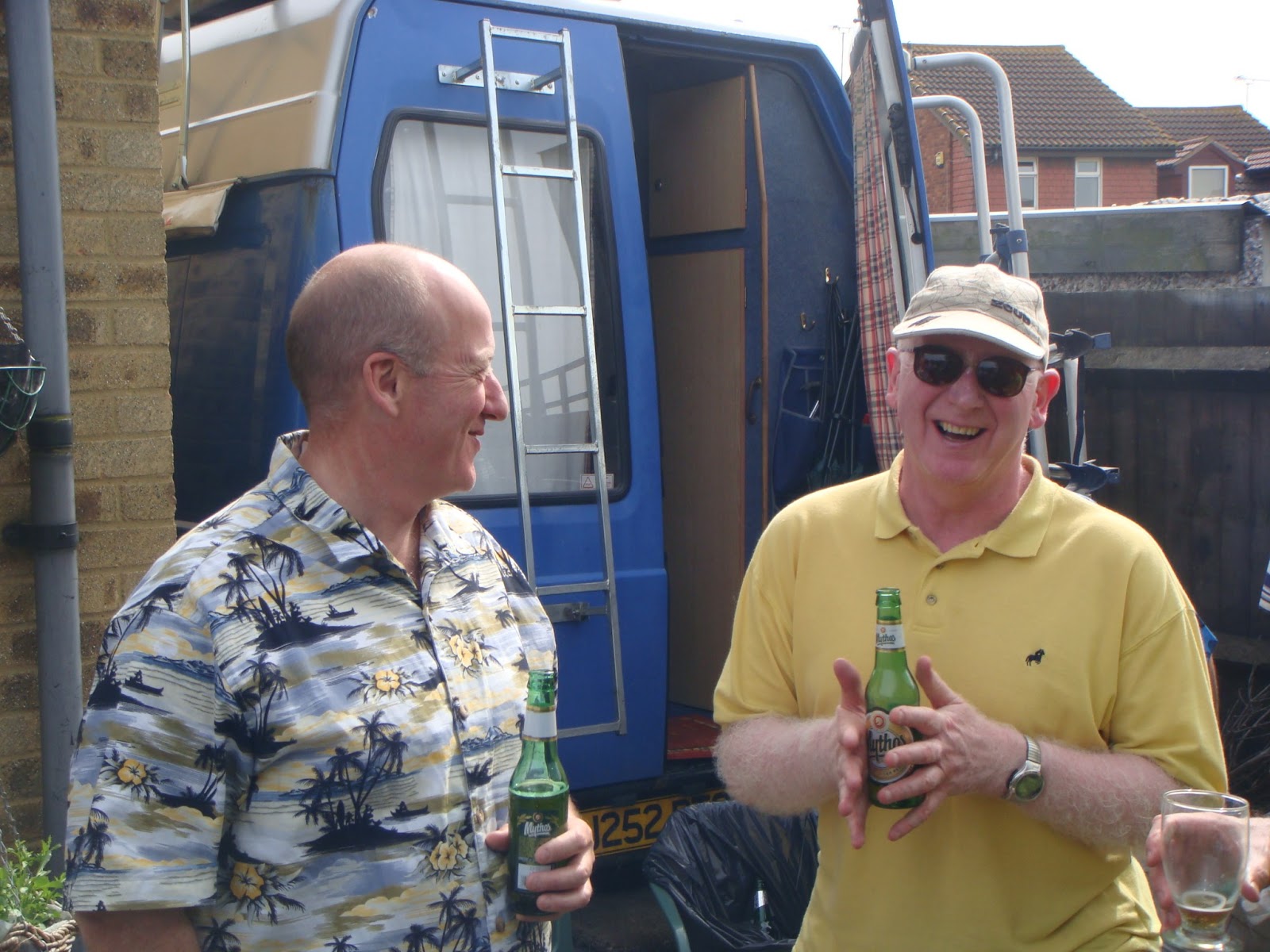
Hugh and Geoff Gullick enjoying a tincture


Pokey Parkes, one of our best men, with a smile and a pint of beer in hand at 7 0’clock on Saturday evening.


Phil the Grill with a small snack.


Unfortunately I have no record of this conversation.


Pokey Parkes with a cup of tea in his hand at 10 o’clock on Sunday morning.


Sunday, 17 March 2013

Newcastle and Gateshead I


People who have never visited the North East are frequently unaware of the fantastic architecture to be found in Newcastle city centre. In fact, this city has more listed classical buildings than any other city in the United Kingdom, in particular the wonderful range of buildings in Grainger Town, known as 'Tyneside Classical'. There are also several unique bridges crossing the River Tyne, including the iconic Tyne Bridge, the Gateshead Millennium Bridge, the High Level Bridge and the Swing Bridge. The past few decades have also seen an increase in the number of attractive modern buildings, typified by The Sage in Gateshead.


The River Tyne walking upriver along the Quayside


The Crown Posada, The Side in 2004.

The Crown Posada is approximately 250 years old and was named by a 19th century owner and sea captain who had a wife in Spain and a mistress in Newcastle whom he installed in the pub. Posada is Spanish for inn or resting place.
The pub has hardly changed at all since the Victorian era. As you enter the pub from the street you step into a long, narrow room, divided by mahogany and stained glass screens into three areas; a tiny snug, a standing area in front of the bar and a comfortable lounge area with seating. There is an old gramophone on the bar which is still used to play records. I have visited this pub on several occasions and have never had a bad pint!


O’Neill’s, Neville Street
In 1971 the British crime film, Get Carter, starring Michael Cane, was released. Most of the action took place in the North East and Newcastle and Gateshead featured prominently. Now, over 40 years later, these places have changed considerably, but it is still possible to pick out a few of the locations used in the film.
One pub that featured in the film was The Victoria and Comet; this was a really rough pub back in the 1960s and was known locally as the Spit and Vomit. The building still stands, although it has been reinvented as an Irish theme pub called O’Neill’s.
 
The Bodega, Westgate Road, with my daughter, Vicki.
If you would like to taste a range of real ales in Newcastle, look no further than The Bodega. This was originally an old music hall attached to the Journal Tyne Theatre. There are usually 9 real ales on offer; 3 permanent ales and 6 guest ales. The permanents include Durham Brewery 'Magus' (3.8%) and Big Lamp 'Prince Bishop Ale' (4.8%). Weston's 'Old Rosie Scrumpy' (7.3%) is usually available on draught.
This pub boasts a traditional long bar, Victorian stained-glass domes and elaborately tiled floors.
The Bodega, which is Spanish for wine cellar, was originally called The Black Bull Inn, but after closure, it was bought by the Sir John Fitzgerald chain and re-opened in 1995 under its current name.


The Station Hotel, Half Moon Lane, Gateshead

This unassuming little pub is a fine example of the old town pub that is fast disappearing from our streets. It is situated on the south bank of the Tyne in Gateshead, only a short walk from the river and tucked under a railway bridge,


The Station Hotel. Note the narrow, wedge-shaped lounge.
The North East of England seems to have had more than its fair share of engineers and inventors. Perhaps the most famous is George Stephenson, ‘The Father of Railways’ who not only designed and built one of the first steam locomotives, ‘Locomotion’, but built several of the early railways including the Stockton and Darlington railway (the first in the world to carry passengers on a steam locomotive). The rail gauge of 4 feet 8½ inches which he used is now the world’s standard gauge.
 
George Stephenson’s most famous locomotive is The Rocket which is commemorated by the Wylam Brewery in the name of their Best Bitter.
George Stephenson also designed one of the world’s first miners’ safety lamps which he demonstrated at Killingworth Colliery a month before the scientist Humphry Davy presented his design to the Royal Society. Although the two designs differed, Stephenson was accused of stealing Davy’s idea and Davy was awarded a prize of £ 2,000. Later a House of Commons committee exonerated Stephenson and awarded him £ 1,000. Davy and his supporters refused to believe that an uneducated man could produce such a design – both Stephenson’s parents were illiterate and George Stephenson was illiterate until the age of 18 and paid for himself to learn to read and write.
From an early age George’s only son, Robert, worked with his father on several projects and became a successful engineer in his own right. His many achievements included the ‘Planet’, a locomotive far more advanced than the Rocket. He was Chief Engineer for the London to Birmingham railway and designed and built several bridges, including the Royal Border Bridge over the river Tweed at Berwick and the two-deck High Level Bridge for road and rail from Gateshead to Newcastle.


The Bridge Hotel, Castle Garth, Newcastle

This large, comfortable pub, overlooking the River Tyne, always has a good range of well-kept real ale. At the far end of the bar is a raised area with a good view over the Tyne. There is live music (including folk and jazz) most nights of the week in the 1st floor function room.


One afternoon I popped into The Bridge for a swift half (well, pint) and a bite to eat. The landlady mentioned that she had made a few sspecial Scotch eggs. I couldn’t decide which one I preferred, so I tried them all. This photograph shows the haggis egg, the black pudding egg and the bacon and cheese egg served with piccalilli and home-made chutney. They were all absolutely brilliant!


The Bridge Hotel at night


Football fans will be well aware of the fierce rivalry between Newcastle United and Sunderland AFC. However, the conflict between these two neighbouring cities goes back for several centuries to the English civil war when Newcastle supported the Crown and Sunderland the Parliamentarians. But as you can see, some football supporters still manage to get on very well! This photograph was taken a couple of years ago in The Pickwick Pub in Basle, Switzerland and shows Benji Berger, Vicki Allen and Alan Cassidy.


The Tyne Bar, Ouseburn, Newcastle


The Free Trade Inn, St Lawrence Road. Newcastle

The Free Trade is a traditional pub to the east of the city with a fantastic view over the river Tyne. I dropped in here for a quick bevvy with Terry Smith and was struck by how friendly the people in this pub were.


The entrance to The Free Trade Inn.
 
 
A regular enjoying a pint in The Free Trade.


A quiet corner in The Free Trade


Young Terry Smith with the Free Trade cat.


Another view of the river Tyne with the Gateshead Millennium Bridge framing the Sage


Thursday, 28 February 2013

North Yorkshire Villages


North Yorkshire has some wonderful pubs and while many are to be found in the coastal villages and towns such as Whitby, Staithes and Robin Hood’s Bay, there are also several pubs on the moors which are well worth visiting.

Danby


Danby and Ainthorpe are adjoining villages, each with an excellent pub.


The Duke of Wellington in Danby in 1983


The Duke of Wellington in 1983, with my mother, Doris, brother, Martin, and wife, Pam.


Ainthorpe


The Fox and Hounds at Ainthorpe, Danby, North Yorkshire. This former 16th Century Coaching Inn is now a high quality residential Country Inn and restaurant.

 
My brother and I in the Fox and Hounds. The stone fireplace allegedly originated from nearby Danby Castle.

Blakey Ridge


In 2005 my wife and I organized a pub tour of northern England for friends from Switzerland. Here we are standing in front of the Lion Inn on Blakey Ridge. Perhaps the most isolated pub on the North Yorkshire Moor, where, if you get lucky, you can be snowed-in for days.
 

Beck Hole


One of the few pubs left that can honestly be called a time-warp, The Birch Hall Inn at Beck Hole on the North Yorkshire Moors. This wonderful pub is situated on the banks of a small river near to the North Yorkshire Moors Railway. This photograph was taken in 1995 and shows my wife, Pam, and our kids, Vicki and Greg.


A tiny bar, but with 6 hand pumps – brilliant!

This is a small pub with just two bars and a sweet shop in the middle. Time seems to have stood still here for generations.


The Birch Hall Inn viewed from the bridge over the Eller Beck. 


As well as a range of cask beer, there is also a simple menu of hot drinks, butties & pies, home-baked scones and the renowned beer-cake. They even have their own Beck Hole Bitter ‘Beckwatter’ which is brewed specially for the pub.


My younger brother about to enjoy a swift half in the small bar of The Birch Hall Inn.
A little gem in a little gem!