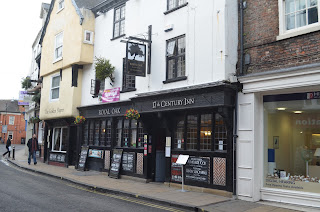
The 21st Century Pub

The pub, with origins going back several hundred years, is under threat as never before. Several reasons have been identified, most notably the availability of cheap (but often inferior) booze in supermarkets, tenancy restrictions and high rents imposed on landlords by the pub owners, and the smoking ban. Sadly, until the government recognizes that these little buildings scattered throughout the country are not only an irreplaceable community focus but also a major tourist magnet, unique to the British Isles and Ireland and contributing significantly to our national wealth, we are in danger of losing them forever.

Can I Do Anything?

Yes, turn your computer off now and go straight to the pub.


Friday, 1 April 2016

York


If you like pubs, you will love York. Although this compact city may no longer have 365 – one for each day of the year – it still has several of outstanding quality.

Unlike many cities such as Liverpool, Leeds and London, which still boast some elaborate Victorian gin palaces, York’s best pubs are more of the street corner variety. This makes them more comfortable and cosy and less intimidating.

York currently has three pubs listed in CAMRA’s National Inventory and twelve more in Yorkshire’s Real Ale Heritage Pubs, also published by CAMRA


The Golden Ball, Cromwell Road. 1996

This small Victorian local was remodelled in 1929 by John Smiths of Tadcaster and features extensive glazed brick and tiles. This photograph shows my wife, Pam, waiting patiently outside for opening time.


The unusual tiled bar front in The Golden Ball 1996


The Black Swan, Peaseholme Green. 2006
Not always a pub, this mediaeval timber-framed building, dating back to 1417, was originally a private house. Reputedly haunted by several ghosts. During the 18th century, this house was occupied by the parents of General Wolfe, one-time commander of the British army in Canada. 


The Blue Bell, Fossgate. 2006

Easy to pass by, this genuine Edwardian pub is one of York’s great hidden treasures. Unassuming from the street, the splendid Edwardian interior enabled this pub to be awarded Grade II* listed status.

Glazed serving hatch in The Blue Bell. January 2015 


The York Tap, York Station. January 2015
This pub is proof that some things do get better with age. This fine Victorian building at York station was originally the station tea room, but opened as the York Tap in 2010. Considerable restoration was required, but this pub now boasts Art Deco stained glass windows, original terrazzo floor tiling and an ornate ceiling. An extensive range of beers is always on offer, many from local micro-breweries.

One of The York Tap’s individual hand pulls. January 2015

The York Tap, June. 2015 - The irrepressible Steve Barnett in his natural environment.


Tony Doyle, outside The York Tap in January 2016, celebrating the fact that he has never been ejected from this pub.


The Snickleway Inn, Goodramgate. January 2015

This 15th century pub is reputedly the most haunted in York. There are certainly some strange stories associated with this building. Occasionally the smell of lavender is noticed throughout the pub. This is said to relate to the practice, many centuries ago, of keeping plague victims in an upstairs room. Lavender was used to mask the smell of the deceased. I know from my own experience that lavender does, in fact, have a persistent aroma. Several years ago I was walking home having partaken of a few sherbets when I stumbled and fell into a lavender bush. I finally made my way home, and to bed. In the morning I had all but forgotten about this little mishap – until the smell of this plant returned to haunt me. Other spirits at The Snickleway include Mrs Tulliver and her car, Seamus and the ghost of a young girl, believed to be the daughter of a previous landlord, who was killed outside the pub by the brewer’s dray. The most malicious ghost is said to be that of an old chap who sits on a barrel in the cellar and throws objects at the staff when they go down there.

For those of you wondering, ‘snickelways’ is a York expression for small paths between buildings. It is a relatively new word coined in 1983 by the author Mark Jones from three words, snicket, ginnel and alleyway.


The Golden Slipper, Goodramgate. January 2015
During alterations in 1984, workmen found a mediaeval leather slipper which is believed to have been built into the 14th century building to ward off evil spirits.


The Punchbowl, Blossom Street. June 2015
Alfresco drinking with Steve Barnett, Jones the Beer, myself and Tony Parry.


A few late afternoon bevvies in The Punchbowl, and Steve’s expression says it all.


The Maltings, Tanner's Moat. January 2016

Jones the Beer and Tony Parry enjoying a pint in The Maltings.


Tony Parry, Barfly, Bill Chilton and Jones the Beer in The Maltings.


A congenial team photograph – unexpectantly photobombed by the pub landlord.


Barfly, Yozza Hughes and Jones the Beer enjoying a quiet pint in The Maltings. The following three pints were considerably noisier.


The Swan, Bishopsgate. January 2016
This unpretentious street corner pub was built in Victorian times but it is the remodelling performed in 1936 which gives this building its listing as a heritage pub. Little has changed from this time. Rare features include the unaltered room layout, serving hatch, bell pushes, leaded and glazed screens and terrazzo flooring. This is one of three York pubs listed in the CAMRA National Inventory.

Glazed panel above the main entrance to The Swan.


The Kings Arms, King’s Staith. January 2016
Situated on the banks of the River Ouse, this pub is known nationally as ‘The Pub that Floods’. There is a plaque inside the front door which shows the height of the water on past occasions.


The Roman Bath, St Sampson’s Square. January 2016 
In 1930, renovations to this pub revealed the remains of a caldarium, or steam bath, from the Roman city of Eboracum. The caldarium and a neighbouring plunge bath have been excavated and can and visited from inside the pub. 


The Three Cranes, St Sampson’s Square. January 2016
I remember visiting this pub in the 1980s when it was run by the redoubtable Mrs. Barnett,
mother of Steve.


Ye Olde Starre Inn, Stonegate. January 2016
Believed to be one of York’s oldest pubs, this pub has undergone several changes over the centuries. There is some interesting late 19th century decorative leaded glass in the main bar.

Main bar of Ye Olde Starre Inn.


Monday, 21 April 2014

Blackhall Colliery


For a pub blog, the inclusion of Blackhall Colliery in County Durham is an odd choice. Although the village has a population of around 3,000, it currently has only one pub. I have included Blackhall because it is part of North East England’s rapidly-disappearing industrial heritage and because it was a village I knew well as a child - I attended the Infants and Junior schools there and my father taught at Blackhall Senior school in the 1950s and 1960s.
Blackhall Colliery is a former mining village on County Durham’s North Sea coast, but 100 years ago there were only a few scattered farms in this part of the county. After the mine was sunk in 1913, a new ‘modernised’ colliery village was created within a few short years. By 1920, there were around 500 houses, shops and other buildings.


Blackhall Colliery is connected by rail to Horden to the north via a spectacular brick-built viaduct. This crosses Castle Eden Dene, a Site of Special Scientific Interest and a National Nature Reserve, at Denemouth. The railway was completed in 1905. This photograph was taken in 1993.


A Blackhall Colliery back street in 2007. Note the outside coalhouses and toilets, now all converted to sheds.


There were four classes of houses built in Blackhall Colliery, ranging from the Class 1 terraced houses with four rooms, two up and two down, plus wash house and kitchen, to the Class 4 houses which were far more spacious and were designed for the colliery officials. All houses had outside earth closets and a coalhouse. Sites were set out for a hospital, a church and vicarage, a theatre, a Working Men's club, a school, a park with bandstand, and two hotels/public houses. There was, however, a complete lack of imagination when it came to naming the streets. The rows of houses were named ‘First Street’ to ‘Eleventh Street’ and the main road through the village was called ‘Middle Street. There was also an ‘East Street and a ‘West Street’.

The Hardwick Hotel, on the imaginatively named Middle Street, is the only remaining pub in Blackhall Colliery. It was built in 1914 by Nimmo’s brewery of Castle Eden.


The Hardwick Hotel in 2007. Note the delicate metalwork to either side of the central window advertising the brewery which commissioned the building.


Castle Eden Brewery in 1987
Castle Eden Brewery was founded by John Nimmo in 1826 and remained independent until it was sold to Whitbread in 1963. Brewing ceased in 2002 and most of the buildings were demolished in 2003. In 1968, I had a Christmas job here working in the bottling section. I can’t recall much about my time at the brewery, other than my boss who was a ferocious woman we called ‘Lily the Pink’ after a current pop song. This dreadful woman would launch into a verbal attack every time a crate of beer fell off the conveyer belt.


The Chimneys Guest House in 2007. Built in 1925, this building was originally a pub known as the Blackhall Hotel, or locally as The Trust, after the company who constructed the building.

Blackhall Secondary Modern School in 1993. My father’s classroom was the left hand section of this prefabricated building. The school was closed at the time these photographs were taken, in 1993, and was subsequently demolished.


Blackhall Secondary Modern School, Science Room, 1993.
After school, my father would occasionally bring my brother and I here and show us all sorts of scientific tricks. We learnt how to clean pennies using dilute nitric acid, how to blow glass into interesting - but wholly useless -  shapes, the wonders of a Van de Graaff generator, how to repair a valve radio, how to make gunpowder and, best of all, how to make nitrogen triiodide.


My father, teaching in the 1960s. This lesson was not part of the curriculum.
In 1963 my father organized a visit to the colliery for the older lads in his class. Most would be leaving school at 16 to work in the mine. Although I was only 13 and my younger brother was 11, he arranged for us to join the party. The concept of Health & Safety was not well established at the time. The descent in the cage below ground, the journey to the coal face by conveyer belt and on foot and the realization that we were several hundred feet below the North Sea, are experiences I will never forget.


This photograph shows my junior school class sometime in the mid-1950s. I am the young lad in the middle of the crowd.


Blackhall beach in 1986, three years after the coal mine closed. Coal waste had been tipped at sea along this coast for many years producing an eerie, unearthly landscape. This beach featured in the final scenes of the 1971 British gangster film, ‘Get Carter’ starring Michael Caine.


In 1986, the sea along this coast was still throwing up coal waste.


Blackhall beach in 1993. Much of the coal waste has already disappeared and, following a major clean-up project at the start of the millennium in which 2 million tons of waste were removed, the coastline has now returned to its pre-industrial state.
I’d like to complete this post with a well-documented, but nearly-forgotten, tale of a local sea monster. In 1850, four people, including Mary Burden of Castle Eden, independently reported seeing a sea-serpent off Blackhall beach. At first sight, Miss Burden thought the creature to be a whale – she had seen some previously in the North Sea off Tynemouth – but when the sea creature reared out of the water and displayed two coils before swimming away at speed, she took it to be a sea serpent.
This may be the reason people refrain from swimming in the North Sea. Then again, it may simply be the temperature of the water.

Tuesday, 26 November 2013

Whitby Pubs 1


There is no doubt about it; Whitby is absolutely stuffed with history.

Captain Cook set sail from the harbour in Whitby-built ships on his journeys of discovery, Dracula arrived at Whitby harbour in a storm, Queen Victoria established the fashion for jewelry made from Whitby jet, after the death of her husband, Albert, William Scoresby moored his whaling vessels here, Oswy, an early Christian king of Northumbria,  established the first abbey in Whitby, the Synod of Whitby met here in 656 and found in favour for the Roman church over the traditional Celtic form of Christianity in Northumbria – I could go on, but there is even more to Whitby than history.
Today the town is one of the most picturesque harbours in Britain, with plenty to offer visitors including the annual folk festival, the twice-yearly Whitby Goth Festival, a Victorian railway station with links to the North Yorkshire Moors Railway, fabulous fish and chip shops, Fortune’s oak-smoked kippers, several independent shops, sandy beaches (with donkey rides) and, of course, a splendid range of pubs.


The Black Horse on Church Street.

Of all the pubs in Whitby, this is my favourite. In fact when I am in the town I find it very difficult not to pop in for a pint.
 
The tiny main bar in The Black Horse. As well as wonderful ale, his pub offers an impressive range of snuff, if you are so inclined.
Martin, Pam and Vicki enjoying a pint in The Black Horse in 2013


The White Horse and Griffin on Church Street in 1995.

This old inn now trades as a restaurant.
Built in 1691 by Sir Hugh Cholmley, the White Horse & Griffin was the first Coaching Inn to operate from Whitby to York and London in 1788. Many famous people have stayed here over the years, including, of course, Charles Dickens. This chap is associated with so many hostelries around England; it is surprising that he found time to write any novels.


The Dolphin, Bridge Street

 
The Dolphin is situated on the banks of the River Esk, adjacent to the swing bridge that links the East side of the harbour with the west. Over the years my visits to this imposing brick-built pub, with impressive views over the river, always left me feeling it had never reached its full potential. On one occasion we spent a couple of nights here and experienced what must have been the smallest bathroom in existence. The tiny plastic shower, miniscule plastic sink and molded plastic WC were all packed into a plastic box about the size of a Tupperware box. Since my last visit, however, The Dolphin has undergone a complete refurbishment and recent reviews are very positive.

Three Jolly Sailors pictured outside the eponymous pub on St Anne’s Staithes in November 2013.

More like escapees from ‘Last of the Summer Wine’


The Elsinore, Flowergate.

The Whitby Gothic Weekend was established here in 1994 by Jo Hampshire. This is a superb pub where it is quite easy to spend a complete evening. In fact I have already done so.


The Golden Lion, Golden Lion Bank

A view from inside The Golden Lion. This quirky little pub is recognized as the oldest inn in Whitby.

The Golden Lion – just as you enter


The Board Inn and The Duke of York, Church Street in 1995.

Both pubs are well worth a visit. The Duke has some impressive views over the lower harbour.


Be prepared to meet many strange and wonderful creatures if you visit the town during Whitby Gothic Weekend.


A group of Goths at the bottom of Whittby’s famous 199 steps.


A piratical Goth and his lady.


Attractive young Goths in Whitby churchyard


He’s not really dangerous – so long as you don’t look into his eyes!


Vampires everywhere


The Little Angel, Flowergate.

A friendly pub frequented by Goths. This building is thought to date back as far as the 12th Century.


The Station Inn, New Quay Road


If you plan to leave Whitby by train, allow yourself a little extra time to visit The Station Inn for a pint or three. This pub has a well-deserved reputation for the range and quality of its beer.


The New Angel, New Quay Road.

This historic old inn has been acquired by Weatherspoons and given a new lease of life.