The 21st Century Pub

The pub, with origins going back several hundred years, is under threat as never before. Several reasons have been identified, most notably the availability of cheap (but often inferior) booze in supermarkets, tenancy restrictions and high rents imposed on landlords by the pub owners, and the smoking ban. Sadly, until the government recognizes that these little buildings scattered throughout the country are not only an irreplaceable community focus but also a major tourist magnet, unique to the British Isles and Ireland and contributing significantly to our national wealth, we are in danger of losing them forever.

Can I Do Anything?

Yes, turn your computer off now and go straight to the pub.


Tuesday, 17 September 2013

Sunderland Pubs - 2


Currently there are plenty of pubs closing, but in this post I want to highlight a few great pubs which are not only surviving, but are thriving, despite the best efforts of short-term planners and get-rich-quick merchants.


The Dun Cow, High Street West, in 1990.

This pub, built between1901and 1902, was designed by the renowned architect
B F Simpson. The bar is one of the few pub interiors of special historical interest in Sunderland. There is extensive Art Nouveau woodwork and a back bar that has been described by CAMRA as one of the most stunning in Britain.
 
 
The Dun Cow. The main front bar is separated from a small rear sitting room by a curved wooden and glass screen.


The fabulous back bar in The Dun Cow. One of the most ornate surviving back bars in Britain.


Fitzgerald’s on Green Terrace.
I’m not a great fan of pub chains, but the Sir John Fitzgerald group is a notable exception. This small, family-owned company has been in business for several generations and runs 15 pubs in the North East.
Fitzgerald’s in Sunderland is a traditional pub frequented by students, locals, regulars and visitors to the city and is a regular winner of CAMRA Real Ale awards, boasting a bar full of guest beers.


Two old friends of mine, Terry ‘Smudger’ Smith and Tony ‘Ginger’ Doyle, enjoy a swift half with Terry’s son, Chris. This photograph was taken in The William Jameson, a Weatherspoons pub in Sunderland, on the day when Sunderland played their first home game of the 2013/14 season against Fulham. As you can see by the smiles on their faces, this photo was taken before the game.


Another photograph taken in The William Jameson, this time showing another old school friend, Tommy Lee (right) and his wife, Janet (left) with a couple of their friends. Tommy was a great footballer at school and had trials for several professional clubs. He is the only lad I know who turned down a trial with Manchester United.

The last pub in this post is a real success story. A few years ago The Isis on Silksworth Row in Sunderland was an abandoned and dilapidated Grade II-listed Victorian pub. With great foresight, the owners, The Jarrow Brewery, have bucked the trend of pub closures and have invested £500,000 in a fabulous refurbishment.


This photograph of The Isis was taken in 1990 when the future of the building was far from certain.


The Isis reopened in 2011 and is now booming with a full bank of twelve hand pumps all delivering excellent ale. In truth, I didn’t try them all on this occasion, but the ones I did sample were in top condition. This picture shows the landlord, Christopher Taylor, in action.


Originally this pub was known as The Ship, but after the crew of a ship called ‘The Isis’ were regularly paid off in the bar, the pub officially changed its name to The Ship Isis. The Jarrow Brewery commissioned a specially made ‘Isis’ mirror which shows a beautiful image of the ancient Egyptian goddess.

The pub – reputedly the city’s most-haunted – showcases the brewery’s range of award-winning, traditionally brewed real ales, such as Rivet Catcher and Venerable Bede as well as many other beers from the region.

The Isis has featured in local history books and television programmes due to its reputation of being haunted. Mary-Ann Cotton, the Sunderland-born serial killer, is rumoured to have buried two of her children in tunnels which lead from the pub’s cellars down to the river bank.


Both downstairs bars were busy when I visited, but if you fancy a quiet pint there are further rooms upstairs.
After historical research, the Isis has been restored to its multi-roomed, original layout, and now has its original fireplaces.


The ship’s wheel draped in hops provides a dramatic ceiling decoration in the main bar and a link to the pub’s maritime past.


This view from the upstairs lounge in The Isis shows Sunderland football club’s Stadium of Light on the north side of the river Wear.

Wednesday, 21 August 2013

St Ives, Cambridgeshire

St Ives, Cambridgeshire
During the early 1970s, I became alarmed at the number of pubs closing or being modernized to fit some corporate image and the seemingly unstoppable expansion of plastic pubs. When my wife, Pam, and I moved to St Ives, a lively market town with several pubs, I took the opportunity to take some photographs for posterity. On a positive note, several of these pubs still seem to be thriving.


The Golden Lion, Market Hill, St Ives. Oliver Cromwell, the one-time Lord Protector of the Commonwealth, appears to be looking down from his pedestal, defying anyone to enter the pub. Cromwell lived in St Ives from 1631-1636. The statue was paid for by public subscription and erected in 1901 after an attempt to raise funds for a statue in nearby Huntingdon, where Cromwell also had strong associations, failed.

The White Hart, Sheep Market, St Ives. An old coaching inn dating back to the early 18th century and a Whitbread house at the time the photograph was taken.


The Manchester Arms, Needingworth Road, St Ives.

The Nelson’s Head, Merryland, St Ives. We were regulars at this pub when we lived in St Ives and it was a basic, friendly, back-street pub run by Nancy and Fred. I called in The Nelsons for a pint or two a few years ago and although the interior looked unrecognizable from the 1970s, the restoration (and enlargement) had been very well done.


Advertising has moved on since Fred and Nancy’s time, but if you were a loyal customer back then, you may have been lucky enough to receive a special Nelson’s Head biro at Christmas.
The Robin Hood, Market Hill, St Ives. This pub was built around 1789 and the building was once owned by the Archbishop of Canterbury.


The Oliver Cromwell, Wellington Street, St Ives. An excellent pub near to the Quayside.


The Black Bull, London Road, St Ives. This pub ceased trading in 1999 and is now an Indian restaurant. Note the sign advertising Tolly Cobbold Ales, the Suffolk brewery that was acquired by Ridley’s brewery in 2002. In 2005, Ridley’s was bought by Greene King and two old names were lost.


The Dolphin Hotel, London Road, St Ives. This pub had been derelict for some time when I photographed it in the late 1970s. It was subsequently demolished and a new hotel built near the site.

The Greyhound, Carlisle Terrace, St Ives. This pub was refurbished and renamed The Unicorn in 2003.


The Seven Wives, Ramsey Road, St Ives. This pub was built in 1962 and is named after the rhyme/riddle which dates back to around 1730.


The Dun Horse, Ramsey Road, St Ives, with what looks like a plastic Watneys Red Barrel stuck on the wall next to the entrance. This pub was known as The Aviator from 1992 and is still a pub, but now trades as The Merchant House.


Royal Oak, St Ives. This pub claims to be the oldest in the town, dating back to 1502. The name, however, must be more recent as The Royal Oak refers to Charles II’s famous escape from Oliver Cromwell’s Roundheads in 1651 when he hid in an oak tree.
Note the Ansells brewery lettering. Ansells was, together with Ind Coope and Taylor Walker, a member of Allied Breweries. Ansells Mild and Best Bitter are currently produced for Allied’s successor, Carlsberg, by JW Lees.

The remains of the Cherry Tree Inn, Merryland, St Ives. It seems to be suffering from a little fire damage.


Pam outside the Blue Ball Inn, in the village of Toseland, a short drive from St Ives. This pub was a genuine time warp and was described in the 1976 CAMRA publication for Real Ales in Cambridgeshire (cost 25p) as a ‘Quiet and unspoiled rural pub’

Not a pub, but St Ives Railway Station shortly before demolition.


In the late 1970s, we were involved in organizing some Real Ale festivals at Cromwell House in Huntingdon, birthplace of Oliver Cromwell, Lord Protector. I don’t think Oliver would have approved of our endeavours, in particular the Yard of Ale contest that resulted in a tie and had to be re-run.
In 1978, Pam and I attended the CAMRA Annual General Meeting in Cardiff with our friends Mick and Dianne Shanley. This photograph was taken outside the Queens Head in Stowe-on-the Wold where we stopped for some light refreshment on our drive back to St Ives. Mick Shanley, a connoisseur of ale, is the only person I’ve ever met who routinely put ice cubes into his pint.


I recently heard from Mick and he explained that he started to take ice in his beer while on a University coach trip to a brewery in Tadcaster;  ‘we stopped on the way back at a pub in Blubberhouses and I put my pint on the top of the fireplace and the tankard became a little warm so with my next pint I asked for a bit of ice as well .. I’ve never looked back!  …I knew that it would keep me skinny.’

Thursday, 27 June 2013

Alnmouth


Alnmouth from the south


If you are ever in Northumberland, then you must visit Alnmouth, a quiet, picturesque village with a natural harbour on the Northumberland coast. The area has been inhabited since the Bronze age and, through the centuries, has experienced both prosperity and poverty. At one time Almouth was an important trading port, notably for the export of grain. Many granaries survive today as private houses.

In 1779, during the American War of Independence Alnmouth was attacked by the American privateer, John Paul Jones, who fired a cannonball at the town. His aim was poor and the cannonball missed its target and landed in a field before striking a farmhouse roof.

The fortunes of Almouth declined rapidly after a violent storm hit the coast in 1806, resulting in the river Aln changing its course.

Today Alnmouth boasts four pubs - The Red Lion, The Sun Inn, The Schooner Hotel and The Hope and Anchor Hotel.


The Red Lion


The Red Lion started life as an 18th century coaching inn and today is an excellent pub serving splendid beer and good food. The cosy lounge bar has extensive wood panelling which allegedly came from the RMS Carpathia, the ship that went to the rescue of the doomed Titanic in 1912. However, the Carpathia, which was built a few miles down the coast at Newcastle, was torpedoed in deep water off Ireland in 1918 and sank, so the story may be apocryphal – unless the panelling was removed prior to its sinking.

The Schooner Hotel

The Schooner Hotel is a 17th century coaching inn which was one of the most renowned hotels in the area in the 19th century. It is also said to be one of the most haunted locations in the United Kingdom. Guests have included Charles Dickens, King George III and the founder of the Methodist Movement, John Wesley. After his stay in Alnmouth, Wesley is reported to have said that the village was ‘famous for all kinds of wickedness’.


The Sun Inn


The Sun Inn is another excellent Alnmouth pub, with good beer, an open fire and friendly service. Dogs are welcome too.


The Sun Inn - How could you resist not popping in for a swift half?


The Hope & Anchor Hotel


The Hope & Anchor is another friendly Alnmouth pub with a reputation for good beer.


Alnmouth Ex-Servicemens Club


Not really a pub, but the Alnmouth Ex-Servicemens Club does welcome visitors.


Wednesday, 10 April 2013


When I think of Kent, two things spring to mind; hops and oast houses. Kent is renowned for its hops, in particular the East Kent Golding which provides traditional English ale with its distinctive flavour and aroma. Oast houses are those quirky, circular buildings, with a conical roof reminiscent of a drunken witches’ hat, that dot the Kentish countryside. Oast houses go back 500 years and were specifically designed to dry hops prior to their journey to the brewery. Today the drying process has been industrialised and most oast houses have been converted into residential properties.


The Red Lion, Snargate, Romney Marsh, Kent


The Red Lion, which sits alone at a remote crossroads on the Romney Marsh, is quite possibly my favourite Kentish pub.
 
 
The Red Lion dates back to the early 16th century and the pub has been in the same family since 1911. When I first visited in 2005, the landlady was Doris Jepson, who left London during WWII to work as a Landgirl in Kent. She married the landlord’s son and they took over the pub when her father-in-law died.  As soon as you walk in the front door, you feel you have been transported back to a previous century. Even though there is plenty of WWII memorabilia, this pub has hardly changed since 1890. The painted wood bar front is topped with a marble counter and four handpumps with clips advertising Goacher’s beer from Maidstone in Kent. There are three small rooms, a range of traditional pub games and a very pleasant beer garden.


Doris Jepson, Landgirl and Landlady


My son and daughter, Greg and Vicki, in front of the bar at the Red Lion


The Shipwright's Arms, Hollow Shore, Faversham, Kent

Pokey Parkes, GTG, Hugh and Jones the Beer anticipating the first pint of the day


The Shipwright’s Arms must be one of the most isolated pubs in the country, but one well-worth seeking out. I was taken there by an old friend of mine, John Greene, who lives in Kent and has an extensive knowledge of this county’s watering-holes. The pub is situated at the junction of the Faversham and Oare creeks, a strange corner of the county that the world appears to have forgotten. The building is of white-painted weatherboard and dates back to the 17th century. There is no mains electricity - for cooking, they use Calor gas. When we visited, there was good range of Kentish ales, served directly from the barrel, and we were tempted to try them all. We gave in to temptation. With an open fire, nautical memorabilia and lots of nooks and crannies, this is the sort of pub that makes leaving difficult.


The Rose and Crown, High Street, Elham, Kent

 
The Rose and Crown is an early 16th century timber-framed coaching inn, owned by Britain’s oldest brewer, Shepherd Neame.
The author of “The Scarlet Pimpernel”, Baroness Orczy, allegedly based her hero on a man who regularly dined at the Rose and Crown in Elham, while waiting for a fresh horse before continuing his journey to France to rescue aristocrats living under the threat of the guillotine.


The King’s Arms, The Square, Elham, Kent


This fine pub dates back to the early 15th century when it was a grain store and then a brewery, before becoming a pub. The pub was earlier known as The Cock as cock fights were once held at the rear of the pub. 
Elham's Post Office was closed in 2010, but in 2011, The King’s Arms officially took over this function to become Britain’s smallest Post Office.


The New Inn, High Street, Elham, Kent.

This photograph was taken in 2003, shortly before the pub closed.


The Plough Inn, Lewson Street, Norton, Faversham, Kent

The Plough Inn originates from 1260, is full of character and features oak beams, a large inglenook fireplace and wonderful ale.
 

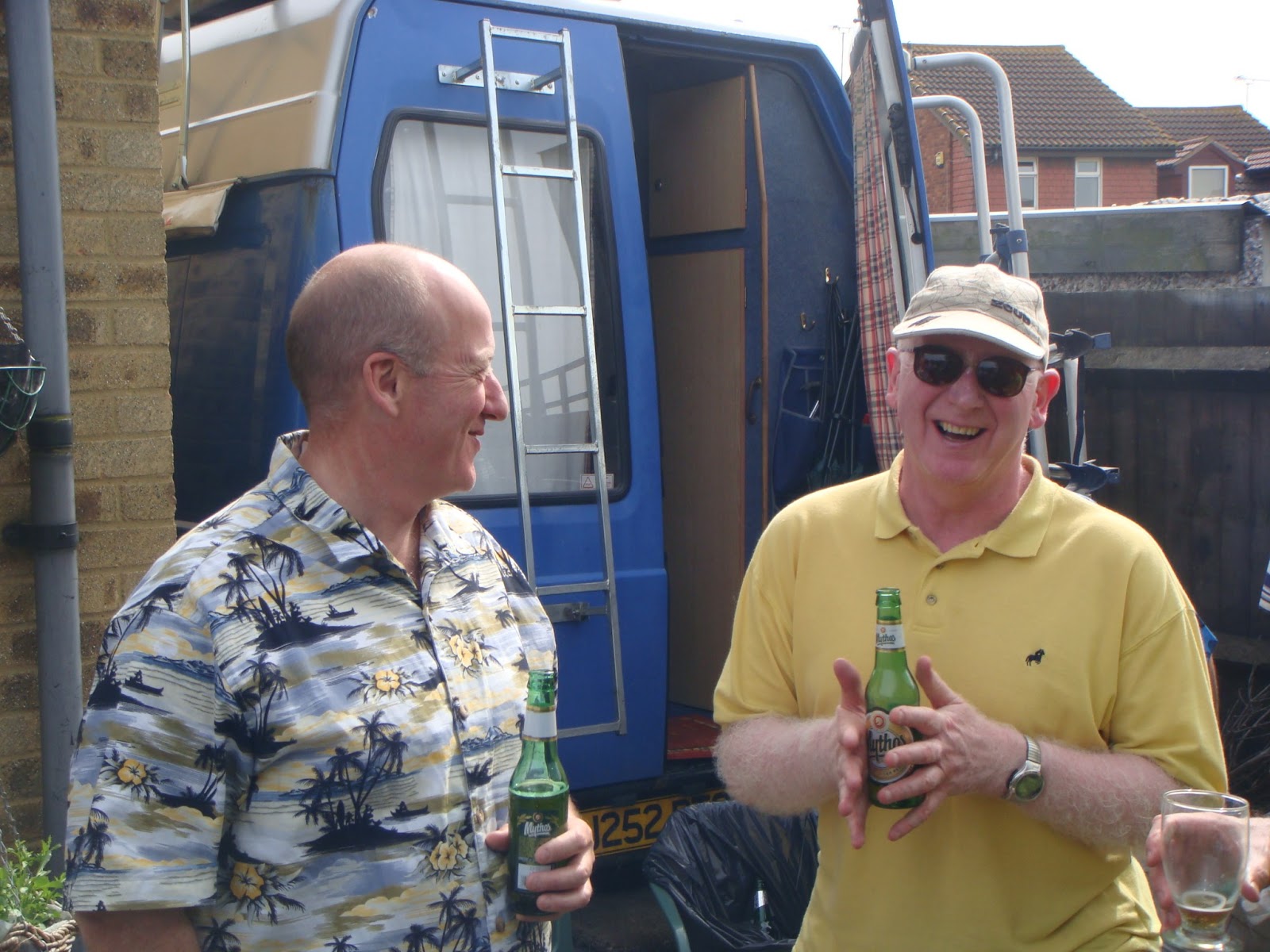
It's always a problem deciding what to do when the pub is closed. In Kent, they barbeque. 


Kentish ladies take Health and Safety seriously, as this sign indicates


John Greene, on the left, demonstrates his latest beer-dispensing gadget


Hugh and Geoff Gullick enjoying a tincture


Pokey Parkes, one of our best men, with a smile and a pint of beer in hand at 7 0’clock on Saturday evening.


Phil the Grill with a small snack.


Unfortunately I have no record of this conversation.


Pokey Parkes with a cup of tea in his hand at 10 o’clock on Sunday morning.